Introduction
This article compiles my notes on an excellent architectural deep-dive by Jeffrey Richter. He outlines how to architect robust AI Agents using Google’s Agent-to-Agent (A2A) protocol for coordination and Anthropic’s Model Context Protocol (MCP) for tool integration.
It is a must-read for anyone moving beyond simple chatbots to complex agentic workflows. You can read the original article here.
1. First Principles: AI Models vs. Traditional Software
Richter starts by contrasting the “probabilistic” nature of AI with the “deterministic” nature of software. This distinction drives the architecture.
| Feature | Traditional Software | AI Models (Humans) |
|---|---|---|
| Input | Precise: Scalars, JSON, XML, Structs. | Imprecise: Natural language, audio, video. |
| Processing | Deterministic: Same input always = same output. | Probabilistic: Subject to interpretation and context. |
| Output | Precise: Intended for other software. | Imprecise: Intended for humans or other agents. |
Key Takeaway:
- Imprecise data is valid input for Humans/AI, but toxic for software functions.
- Precise data is the goal of software, but when AI models attempt to output it (e.g., JSON), they may hallucinate or format it incorrectly.
- The Architecture Gap: We need a bridge to safely turn the Model’s “thoughts” into “executable actions.”
2. The AI Agent Process Flow
An AI Agent is essentially a wrapper around a Model that gives it “hands” (tools) and “memory” (history).
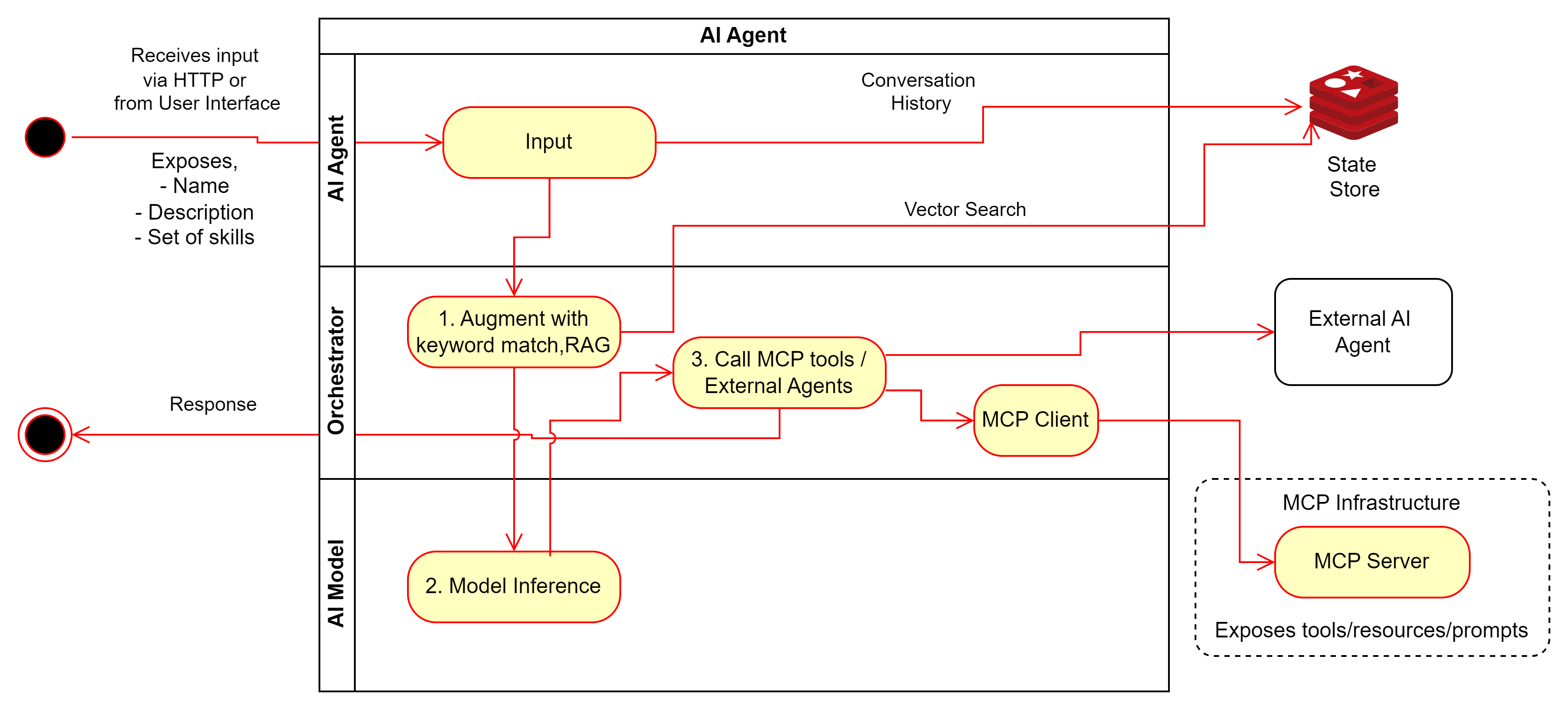
The Agent Orchestration Loop
The Components
- The Agent Interface (A2A): The Agent itself is an HTTP service (or it may provide User Interface) that accepts imprecise input (instructions) and returns imprecise output (answers/results).
- Agent Card: To be discoverable, every Agent publishes an “Agent Card”—metadata containing its name, description, and the set of skills it possesses.
- State & History: Since AI Models are stateless, the Agent must maintain the conversation history. It manages the context window, often deciding which memories to keep or discard.
The Orchestrator Loop
The “Brain” of the agent is the Orchestrator (often built with LangChain, Semantic Kernel, Autogen etc.). Its main execution loop looks like this:
- Receive Message: The Agent receives a task/message.
- RAG Augmentation: The Orchestrator may augment the prompt with domain-specific knowledge (retrieved from vector databases, PDFs, etc.).
- Model Reasoning: The full context is sent to the AI Model.
- Decision Point: The Model outputs either:
- Imprecise Result: Natural language to be sent back to the user.
- Precise Tool Call: A specific request to call a function (e.g.,
get_weather(city="Mumbai")).
- Tool Execution (MCP): If a tool is requested, the Orchestrator executes it (via MCP) and feeds the result back into the conversation for the Model to interpret.
3. The Power of MCP (Model Context Protocol)
While A2A handles Agent-to-Agent chatter, MCP standardizes how Agents connect to their tools and data.
- The Connection: Agents act as MCP Hosts. They connect to MCP Servers (which provide the actual tools).
- Deployment: MCP Servers can be local executables (stdio) or remote HTTP services.
- Discovery: Each MCP Server exposes three things:
- Tools: Executable functions with JSON schemas.
- Resources: Read-only data (like file contents or logs).
- Prompts: Reusable prompt templates.
Advanced MCP Features
- Sampling: This allows an MCP Server to “ask for help.” Instead of just running code, the Server can request the Host Agent to process a prompt using the Agent’s LLM. This is powerful because the MCP Server doesn’t need its own API keys; it just borrows the Agent’s brain.
- Roots: A security/scoping feature where the Agent defines the “root” boundaries (e.g., a specific folder in VS Code) that the MCP Server is allowed to access.
Jeff has covered much more than above summary in the original post, specifically regarding the specific JSON schemas and protocol nuances. Highly recommended reading!
Useful References,
Happy Coding !!